Virtual Reality & Education✓ COMPLETEDTEQIP III
Learning Physics through Computer Vision
Project Summary
“Comprehensive VR simulation platform for Crystal Structure.”
RESEARCH GRANTRs. 2,50,0002019 – 2020
RESEARCH OVERVIEW & DETAILS
Project Scope & Details
Comprehensive VR simulation platform for Crystal Structure.
ARCHITECTURAL & SCIENTIFIC HIGHLIGHTS
01.
Computer Vision Trajectory Tracking
Tracks physical projectile, pendular, and rotational motions in video streams with sub-pixel spatial accuracy.
02.
Newtonian Kinematic Equation Solver
Automated regression solver extracting empirical velocity, acceleration, and damping coefficients from observed video.
03.
Interactive Physics Sandbox
Allows students to overlay theoretical differential equations directly on top of real-world recorded motion videos.
04.
Real-to-Sim Discrepancy Diagnostics
Surfaces real-world aerodynamic drag and frictional losses, teaching students why physical experiments diverge from ideal models.
PROJECT GALLERY [1 PHOTOS]
Click to expandFIG. 01
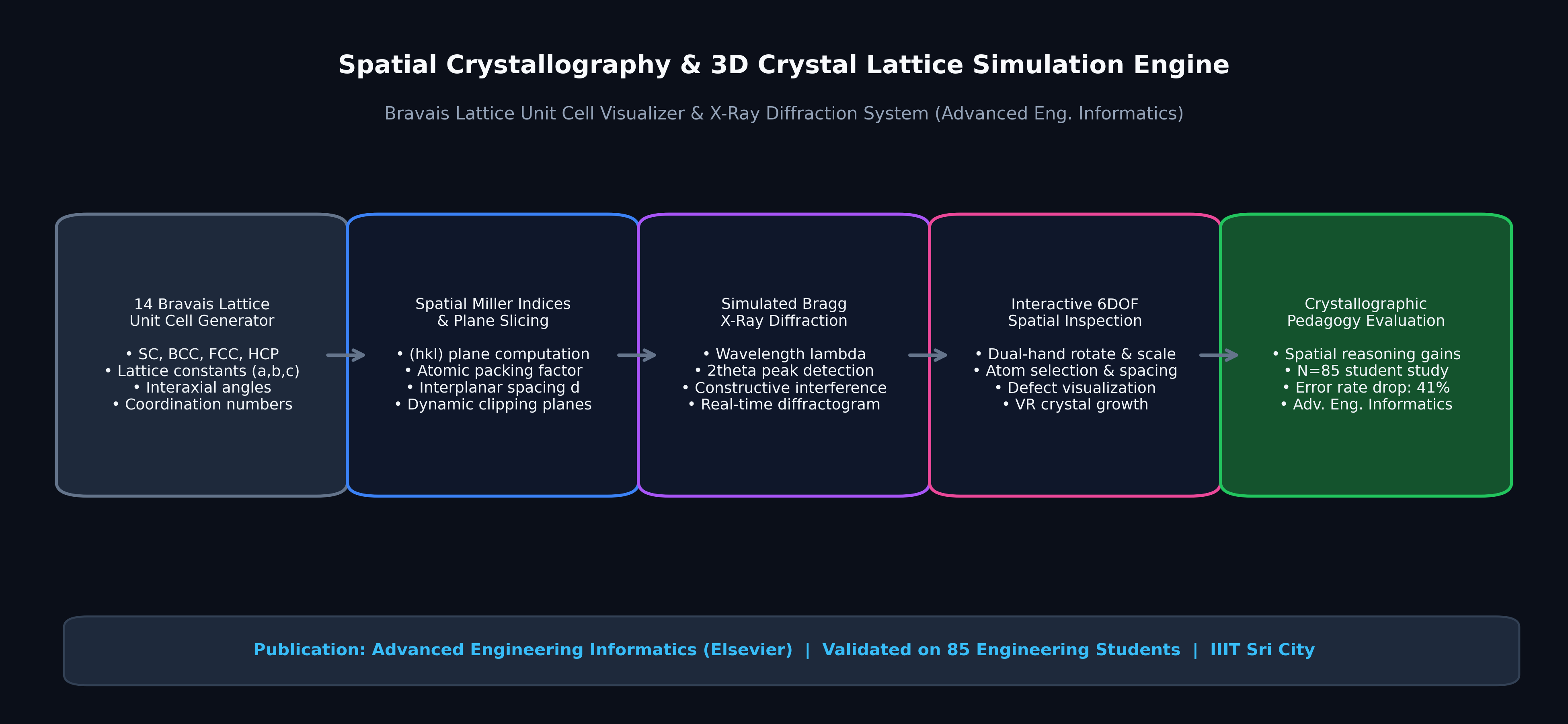
Spatial Crystallography & 3D Lattice Architecture
ACADEMIC PUBLICATIONS [1]
2021Advanced Engineering Informatics
Teaching and Learning Crystal structures through Virtual Reality based systems
Authors: Vishawash Kumar, Sahil Gulati, Bhargab Deka, Himangshu Sarma
RESEARCH TEAM
- Dr. Himangshu Sarma
EXTERNAL COLLABORATORS
- ▸TEQIP III
FUNDING & GRANTS
SANCTIONED BUDGETRs. 2,50,000
SPONSORING AGENCYTEQIP III
PROJECT TIMELINE2019-12-01 – 2020-09-01
TECHNOLOGIES
VR DevelopmentPhysics SimulationEducational DesignUser Experience